
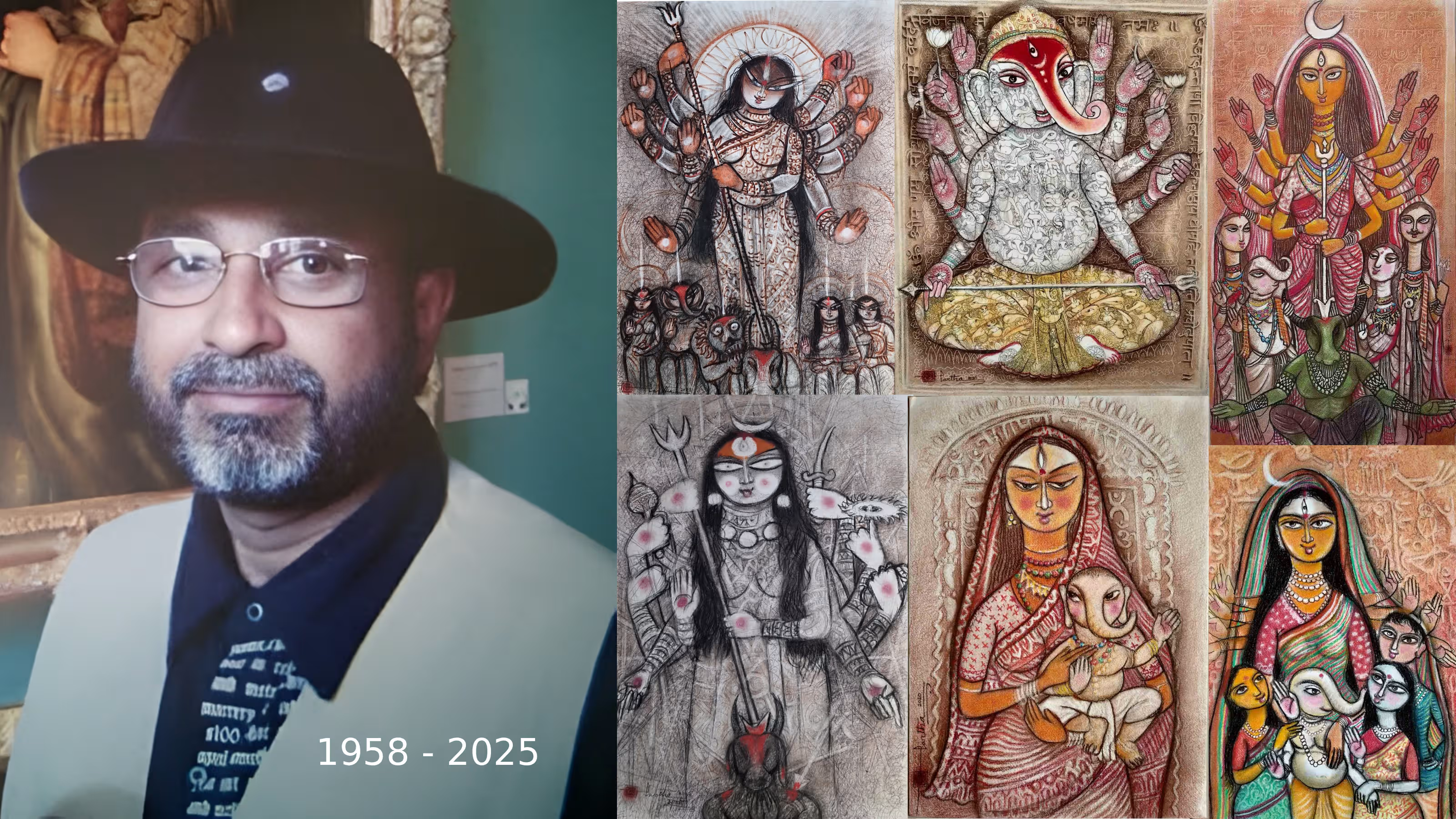
There is a recurring image in the late work of Partha Bhattacharjee that lodges in the memory long after you look away: a trident and a lotus, within the frame. The trident belongs to Durga, the warrior goddess, destroyer of evil, fierce and uncompromising. The lotus belongs to Parvati — her gentle form, the devoted consort, the nurturer. Why, the eye wants to know, are these two things together?
Partha’s answer — painted in dry pastel and the rural folk idiom of West Bengal, by a man whose vision had been seriously damaged by a 2017 cerebral attack — is both theological and personal. Strength and softness are not opposites. They are the two hands of one being. And the place to understand this, he insisted, was not in European aesthetics or academic tradition, but in the soil and scroll paintings and terracotta temples of rural Bengal.
The Education That Mattered Most
Partha was trained at the Government College of Art and Craft in Kolkata — one of India’s finest institutions, where he studied under Bikash Bhattacharjee, Lalu Prasad Shaw, Ganesh Haloi, and Isha Mohammad, and found in Professor Ashesh Mitra a lifelong philosophical guide. He could copy Rembrandt with exhibition quality. He understood Trompe-l’oeil at a cellular level.
But the education that shaped his final and perhaps greatest work was conducted in a different classroom entirely: the remote villages of India.
- Shantiniketan, where Tagore dreamed of art rooted in Indian earth.
- Tarapith, where Shakti worship is ancient and visceral.
- The Sundarbans, where communities propitiate the goddess at the edge of tiger country.
- Raghurajpur in Orissa, where every family practices Pattachitra painting as inheritance.
- Ajanta in Maharashtra, where Buddhist monks left frescoes on cave walls that still breathe, fourteen hundred years later.
He went to learn. He went to listen. And he stored what he found.
What the Cerebral Attack Made Possible
In 2017, a cerebral attack stole much of Partha’s peripheral vision and left him unable to focus precisely on a single point. For an award-winning artist who had built his reputation on photographic realism in oil, this was devastating. He rested. He took medication. He waited.
Then he began again — with dry pastel on paper, in the bold visual language of Bengal’s folk traditions. The precision that oil demanded was gone, but the body remembered forty years of looking and intuition. The hands knew the light on a paddy field at dusk. They knew the eyes of a goddess in a Pattachitra scroll. None of that required perfect vision. It required only the willingness to keep going.
The Durga Series that emerged from this period is some of the most devotionally concentrated work Partha ever made. Conceptually part of his Mahakal Series — which carries his call for peace, equality, and justice — these paintings render Durga and Parvati as two aspects of the same Adi Shakti, the primal divine feminine. The rural art idiom of West Bengal becomes the language through which this theology is expressed: not an academic argument but a village truth, painted with the directness of someone who has spent years listening to what the earth already knows.
The Feminine at the Centre
Throughout his career — from the earliest Family Series paintings of the 1980s to the Devi Series that earned him the President of India’s silver plaque for the best work of 2000-2001, through to the Durga Series of his final years — Partha Bhattacharjee held one belief absolutely: that the supreme life force is feminine, and that it is not distant or ceremonial but present, always, in the women who carry the world on ordinary shoulders.
He felt genuine pain, he said, when he witnessed the plight of women in his time. His art was where he worked out that pain and transformed it into something luminous. In the Durga Series, as in the Devi Series before it, the goddess is never separate from the woman who is suppressed. She is the woman who is supressed. The divine is not the exception to ordinary life; it is the truth underneath it, visible to anyone willing to look with patience and love.
To acquire a work from the Durga Series or the broader rural Indian contemporary art of Partha’s final years is to receive something rare: the full force of a President Award winner artist’s lifetime brought to bear in a single image, made under conditions that would have stopped most people entirely. These are not comfortable paintings. They do not flatter. They were made by a man with compromised sight and an uncompromised spirit, asking us to hold — as he held, right to the end — the trident and the lotus in the same frame.
Partha’s website: https://parthabhattacharjee.com/